Saturday, 8 June 2013

Play Detective

Finding Evidence of Children at Play


Creative play is like a spring that bubbles up 

 from deep within a child.                                                                                                                      Joan Almon


Speaking at a recent event I was drawn to the bush area of the school playground where I found evidence of children having played in this space over a period of time.

With great excitement I became a Play Detective on the trail of evidence of play!

A stick for mixing?
A secret hoard? Currency?
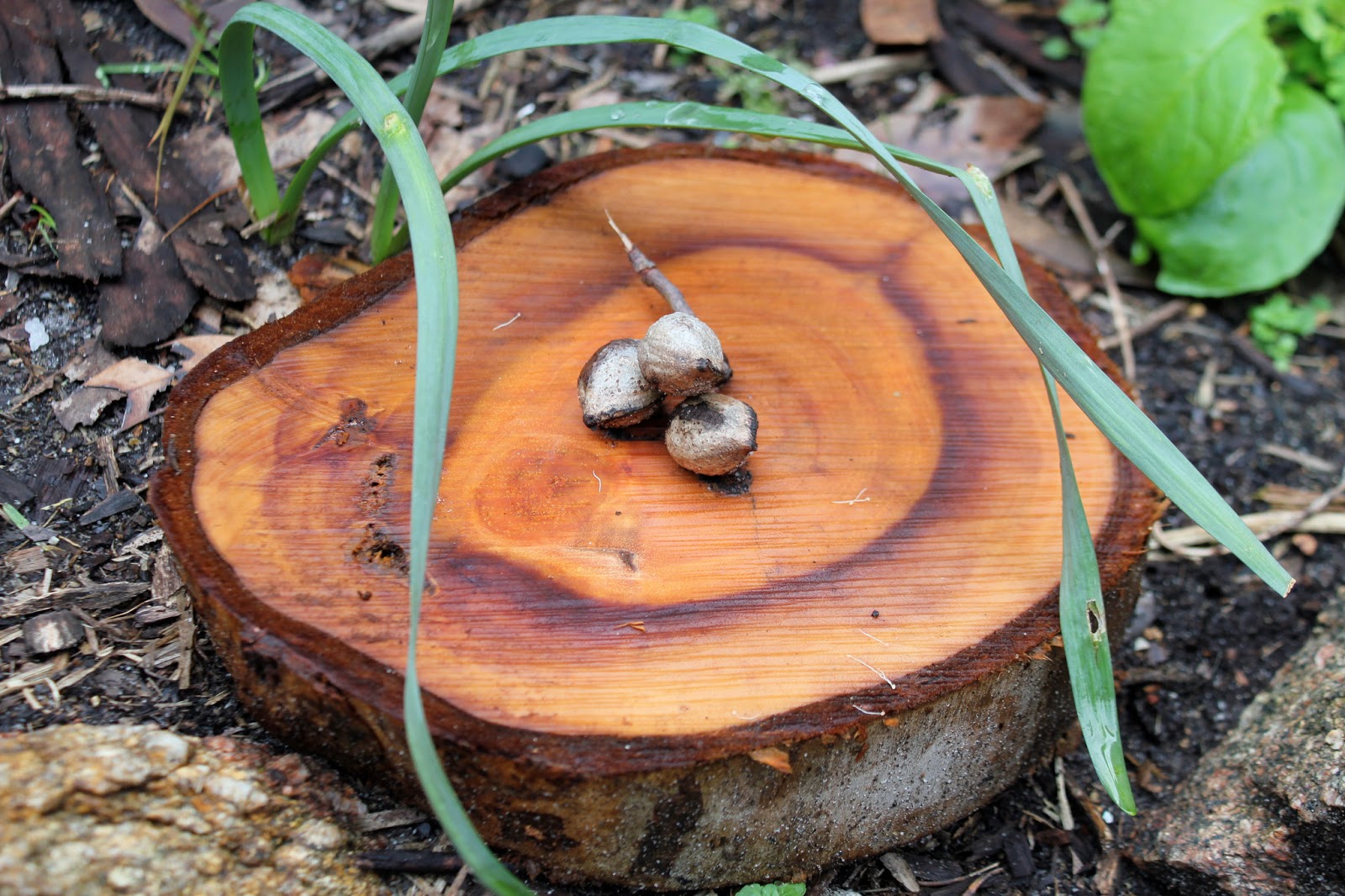
Natural and man made treasures?
 Finding natural elements combined in a variety of different ways brought back memories of my own rich childhood in South Africa. We created dens using gathered grass cuttings to form rooms and doorways. In this Australian space I found similarly constructed cubbies made using the fallen leaves of the She-oaks instead of grass cuttings. There is often a hierarchy in these structures, some positions are more valued than others; children have regular battles or wars with clearly identified rules established by the children and/or passed on from one ‘generation’ to another as children move on and leave the settings or the space. 

Cubbies with walls, entrances and other detail

It fascinates me is that although the actual natural or man-made materials used may differ I have found very similar evidence of children at play in many very different countries - South Africa, Scotland, England, Iceland, New Zealand, Denmark, Norway and Australia. I don’t doubt that I would find similar evidence of children's play in other countries...maybe I should explore more countries as part of my research project!

a rock barbeque?

It is the loose parts in our environment that supports our creativity (Simon Nicholson 1970 - Theory of Loose Parts). Loose parts are natural as well as man-made materials that do not necessarily have a particular function and which can be used alone or combined with other materials.

centred art?
fairy garden?
a mixture?
a meal?
shredded leaf potion?
Children naturally gather ‘loose bits' and tend to give them a 'value' based on how hard it is to obtain them; often these are used to trade or barter for other sought after objects. Stones, sticks, seeds, flowers - not just any but those with particular characteristic as identified by children. 

Objects are usually sorted, often using a variety of complex sorting criteria which may not always be immediately evident to the adult. 
blue flower collections?

a tower?
Children tend to look for find and choose a significant space such as a cleared open patch, a raised surface, hollow, hole or they may choose objects such as a leaf, drainpipe lid, brick, log, stone or a piece of bark, to create a space that will act as the ‘canvas’ or 'frame' for their creation. 

Arrangements are deliberate; circles, concentric circles or spirals, angular shapes such as rectangles and triangles (triangles are often 3 dimensional), lined up next to each other either in rows or in lines, stacked or layered on top of each other – each creation is carefully planned to the smallest detail.

a shop?
Often the objects used have been transported a fair distance away from the source – a stick, seedpod, leaf, stone when there is no evidence of other similar objects in the area – these are treasures specifically chosen by the children and transported to their chosen site.
 
In urban spaces or early childhood settings where there is a lack of natural loose bits children will use whatever loose bits they can find – Lego,bottle tops, plastic scraps, string, paper etc.
stick shop?

Children the world over play and learn in a very similar way when not directed by well meaning adults (ie no adults in their play space!) – irrespective of the curriculum the adults in that country have developed and then inflicted on children. What is important is that the play is allowed to happen over long periods of time without the children's creation being 'cleaned up' by adults so that they can evolve and grow.


As a scientist my nature is to wonder and theorise about what I see and experience; I believe children do the same - they are born little explorers fascinated with the world around them. I have also learnt not to express this wonder with some adults who do not share this with me just as some children lose that awe and wonder if they do not have somebody to share it with. Children deserve to be with adults who share this wonder of the world with them!


table decorations or a posting space?
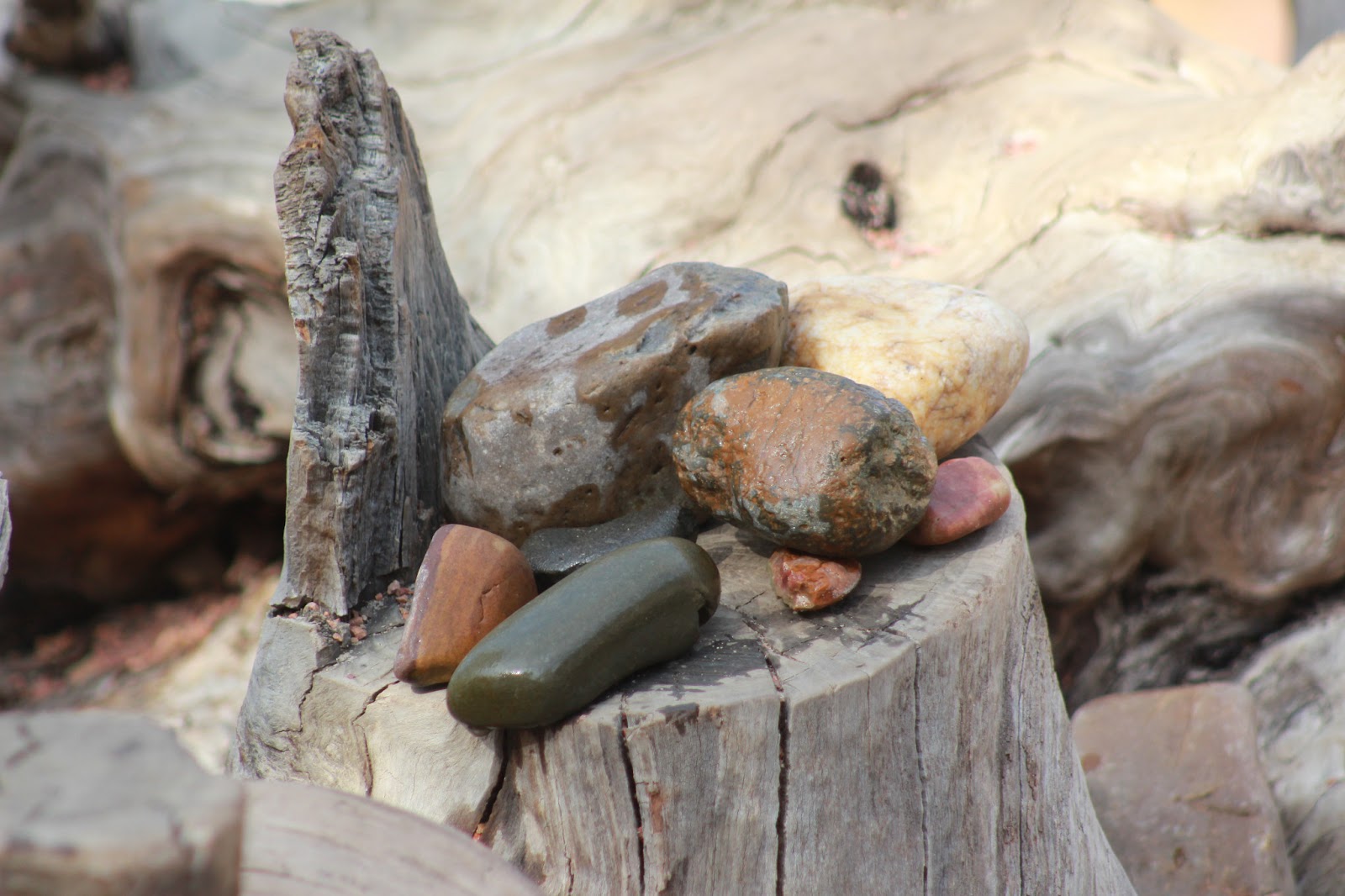
rock treasures?
Play Detectives are researchers – what objects have the children used, why, where did they come from, what have they created, what could this represent, can we support and extend this interest?  By reflecting and analysing the evidence of play we can build up a knowledge and understanding of children’s thinking and their natural patterns of creative play.

a fire?
dinosaur eggs in a natural hollow?

I had found evidence of children at play, real play – self-directed, creative play over which children have ownership and respect for each other’s work. This play takes place over time with children able to go back and make changes on a daily basis. As the adult I do not necessarily need to know what they were thinking but do need to ensure that children have access to such open ended materials or 'loose bits' as well as the time and space to be creative.

 The richness I achieve comes from Nature,

the source of my inspiration. .                                                                                 Claude Monet

Sunday, 31 March 2013

Provocations Bring Back Childhood Memories

A life-long blessing for children is to fill them with warm memories of times together. Happy memories become treasures in the heart to pull out on the tough days of adulthood.  
                                                                                        Charlotte David Kasl

While on a recent business trip to Tasmania I found a shop filled with an eclectic mix of interesting objects. I wandered around reflecting about my age as many of the so called 'antiques' were objects I remember from my youth!! Then I saw it ..... shiny and silver; I tested the handle and it still worked! Vivid childhood memories came flooding back - the sound of metal scraping on metal as you opened it, the smell of hot steam, the reflections of all the shiny metal and of course the heat! I doubt that many other adults wandering through this shop would have had the same reaction to this particular object - an instrument sterilizer!

My father is a Veterinarian although he has been retired for many years; I had just heard that he was gravely ill so my thoughts were very much with my parents so far away in South Africa. As I stood there I was transported back to another era when my father had one of these in his surgery.

Climbing the rough old Mulberry tree outside the surgery window with my brothers, peering in through the slatted glass windows watching my father with his patients while we ate the ripe juicy Mulberries. To see better we would silently try and move the window slats without my father noticing, we also had to avoid getting those ripe mulberries on our clothes - they stain my mum said!
Dogs; big, small, noisy, friendly, scared as well as cats and kittens spitting and hissing or purring. Sometimes there would be birds, guinea pigs, rabbits, parrots, snakes, tortoises and other house pets, I even remember a deer! I was fascinated by everything that I saw and heard  in that surgery.


When I was a bit older I was allowed to come and 'help' in the surgery which made me feel so big and important. I could be present during some surgical procedures, I had to wear gloves, held and passed on the instruments my father needed. The sterilizer was on the counter and I was able to open and close it to get the instruments out although I was not allowed to actually remove the boiling hot instruments. Sometimes when there was not enough water in it the smell changed and the instruments were dry, at other times I had to leave the tray up for a while to allow the instruments to drip dry. I remember the green cloth used to cover the animal to keep the area sterile, I remember the sound of the instruments as they 'clinked' together, I remember the even breathing of the anesthetized animal and I remember my father being fully focused on what he was doing.

I remembered these opportunities so clearly - as if they had happened yesterday although I had not thought of those early years for a long time - all of these triggered by the visual provocation of that instrument sterilizer unexpectedly found in a shop in Tasmania.

Most adults would not have had the same reaction to that instrument sterilizer as we all have different childhood and life experiences but we know that the memories we retain the longest and the best are those linked to just such sensorial experiences. A certain sound, smell, taste, feeling sighting as well as situation can act as the provocation and trigger vivid childhood memories even many years later. These sensory experiences allow long term learning.

As adults we need to ensure that all our children have access to experiences and resources that are highly sensorial  especially in this day and age where children are exposed to so many brightly coloured but basically bland plastic toys as well as over structured opportunities and environments that do not offer children the challenge they crave. These sensorial moments are what build valuable childhood memories. Thank you to my parents for these and many more amazing memories.

“To be in your children's memories tomorrow,
                          You have to be in their lives today.”
                                                                     Barbara Johnson


Wednesday, 26 December 2012

What About The Detail?


The richness I achieve comes from Nature, 
the source of my inspiration. 
                                                                                                      Claude Monet                                     


Walking in the Australian bush is an adventure, there are so many unexpected elements of interest in this environment which are easily missed, to me these surprise elements make the bush experience what it is - and a reason to grab the camera! I have a great love and respect of nature; the perfect detail of even the smallest leaf or bug, which I often only notice through my camera lens, still creates that overwhelming sense of awe and wonder in me. Pattern, shape and colour in nature serve an important purpose and it is this detail that might make a difference in a variety of circumstances.

Some of the range of flowers possibly not noticed in the large photograph!
I have in the past been 'accused' of paying too much attention to detail - why is this so important to me? It is this attention to detail that best demonstrates my respect of the people and the environment I am in - I really care about them which is why I do my best!

It is very often the small things that might be overseen, dismissed or considered unimportant which may make a big difference! Artists know the importance of attention to detail as do bakers, architects, doctors, builders, carpenters, builders, mathematicians, scientists, and doctors! 

At a recent dinner in Scotland I felt the table centre pieces needed some nature added to them - picking up a few natural materials and placing them on the central mirrors to me added the final touch, not critical but still meaningful!

In a recent blog I recalled an experience while traveling that was memorable to me - the small details made a big difference! I linked this to the opportunities we offer young children.

Does attention to detail in creating a high quality play and learning environment for our young children add value to their experiences? Children are aware of minutia, they notice the small things that we as busy and rushed adults often tend to miss - valuing and showing an appreciation of this demonstrates to children the respect they deserve from us.


Stopping and enabling children to closely study a tiny bug or explore the 'mechanics' of nature.

Eating lunch at a beautifully laid table with real cutlery, drinking glasses and a vase of real flowers

Wingate Children's Centre in England
Having access to beautiful high quality resources presented in a respectful manner
Auchlone Nature Kindergarten in Scotland
Giving our full and undivided attention, going down to the appropriate physical level when communicating, asking for opinions and consulting about small and large matters, being respectful of personal dignity and treating others in a manner we would want to be treated are all signs of showing respect but are also part of the finer detail of relationships. It is often the relatively small details in interactions that cause the most hurt or upset; not getting appropriate recognition, feeling an action is unfair, not feeling valued or appreciated - this would apply to humans from birth to 100!

By really caring and knowing the people around us, we can value them for who they are, value their unique strengths and support them in many ways by paying attention to the detail that would mean most to them at that time such as a gentle hug, a card, a kind word, a smile, a flower, a phone-call and other small acts of kindness! Paying attention to the finer detail does equate to being respectful towards those I care about.


Everything that happens to us leaves some trace behind; everything contributes imperceptibly to make us what we are.
 
Johann Wolfgang von Goethe